by Jenny Cernak, Assistant Head of School for Academics
Balancing Joy and Rigor Works
In a world that often feels like it is moving at a relentless pace, it is easy for schools to lose sight of what truly matters. At Kent School, we have intentionally continued to choose a different path. We believe in the importance of simplifying and preserving childhood. By protecting the space for children to be children, we create an environment where learning is inspired to happen naturally, deeply, and joyfully. I am thrilled to share that because of this commitment, Kent School students are truly thriving.
Technology Can Never Replace a Teacher
Lately, there has been much discussion in the broader educational community regarding the challenges and systemic issues facing digital programs like i-Ready mathematics. We want to be clear about our philosophy: Kent School does not use i-Ready to teach our students. Technology should never replace engaging instruction. Instead, teachers utilize the program strictly as a tool for targeted resources and assessment, helping us better understand our students as unique learners. Our priority remains firmly rooted in a hands-on, human-centered approach to teaching and learning.
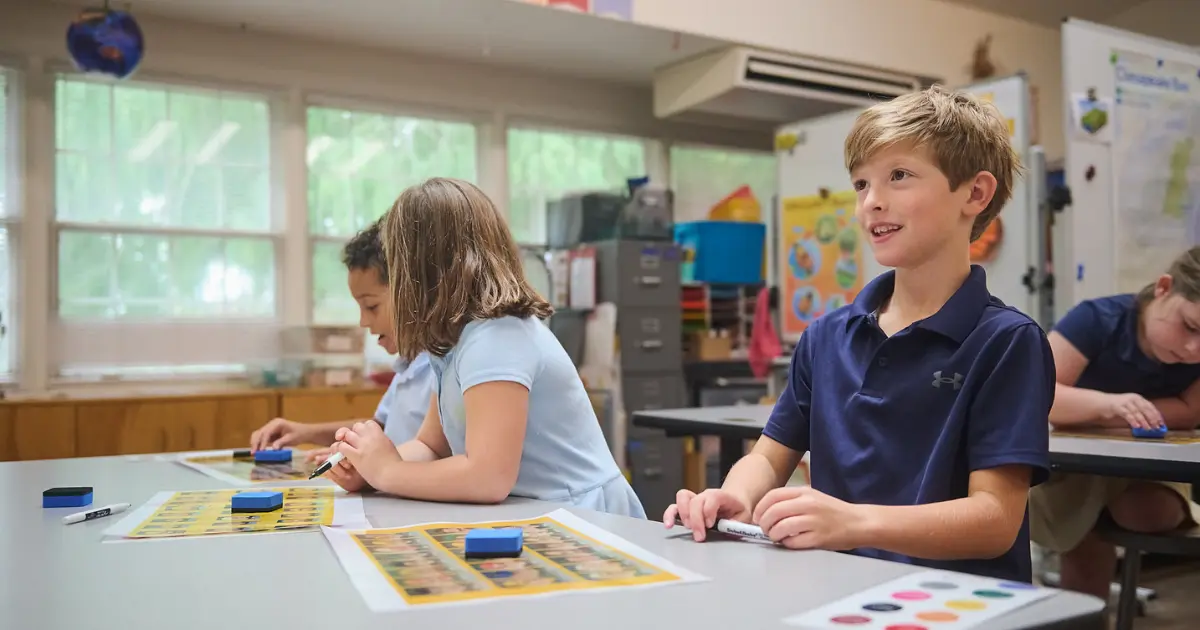
While many public schools are moving back toward offering more recess time, this is not a new trend for us; outdoor play, movement, and exploration is integrated into our culture. We’ve always recognized the value of unstructured play. Moreover, we have leaned heavily into the arts, the sciences, and Social-Emotional Learning (SEL), holding these disciplines in high regard. Our Lower School students enjoy three recesses a day, and last year, we even increased recess time for our middle schoolers. We take full advantage of our beautiful campus, utilizing our physical space in ways that have been proven to benefit long-term learning and directly support our mission to foster active citizens.
Standardized Testing Data Supports Our Balanced Approach
Our balanced approach of combining rigorous academics with the space to breathe and play, yields remarkable results. Students from 4th - 7th grade participate in testing. We recently reviewed our students' performance on standardized testing, which measures national norms across several areas: verbal reasoning, vocabulary, reading comprehension, writing mechanics, writing concepts and skills, quantitative reasoning, mathematics, and science.
Local public schools take state accountability tests (like the MCAP here in Maryland). Those tests are designed to ensure students are meeting the bare minimum state standards. The ERB CTP is completely different. It is a more rigorous diagnostic assessment used primarily by independent schools. It doesn't just check basic grade-level benchmarks; it includes "high-ceiling" questions specifically designed to see how deep a student’s critical thinking and reasoning skills go. The two types of tests cannot be compared directly, because they measure different things. Public school tests look backward to see if a child memorized a specific state curriculum. The ERB CTP looks forward to seeing how well a child can problem-solve, apply logical reasoning, and adapt to brand-new concepts. A state test might tell a parent their child is simply "proficient" for their age. Our CTP results prove that our students are developing the advanced cognitive agility, writing mechanics, and quantitative reasoning that place them well ahead of peers nationwide. In short, students performing well on the ERB CTP is an incredibly strong indicator that they would very comfortably excel on a general public school state assessment. The ERB CTP results are compared with a nationwide sample of students across all types of schools (public, traditional private, charter, and independent schools). The data speaks volumes about the strength of our program and teachers’ instructional success with our students.
In Language Arts and Verbal Reasoning, our students showed incredible strength. Across the 4th, 6th, and 7th grades, every single student scored equal to or above the national norm, with over 51% of our middle schoolers performing entirely above it. Remarkably, 0% of our 4th, 6th, and 7th graders performed below the norm in verbal reasoning, vocabulary, and reading comprehension. Across the entire student body, over 70% performed above national norms in vocabulary, and 57% performed above the norm in writing concepts and skills. Our mathematical foundations are equally robust, with over 63% of the student body performing above national norms in quantitative reasoning.
Preserving a Joyful Childhood
These results are a beautiful validation of our efforts, proving that we do not need to sacrifice a joyful childhood to achieve academic excellence. If you would like to discuss your child’s testing, please contact me to set up an appointment to walk through the results of the assessment.
Looking ahead to next year, we will use this valuable testing data to further refine our practice. We plan to continue scaling back our classroom technology, opting for a more simplified approach where screens are used only when absolutely necessary. By decreasing digital distractions, we look forward to increasing true engagement, deepening connections, and continuing to provide the authentic, hands-on childhood education that allows Kent School students to soar.