
Most schools talk about excellence. Few schools can explain the science behind how their students learn best.
At Kent School, our nine-year partnership with the Center for Transformative Teaching and Learning (CTTL) at St. Andrew’s Episcopal School ensures that our classrooms are shaped not only by experience and passion, but by research. We are proud to be the only PK–8 school in Maryland engaged in this nationally recognized, research-informed professional training.
This partnership reflects a deep and ongoing commitment to teaching in ways aligned with how young minds truly learn.
What Is the Center for Transformative Teaching and Learning?
The Center for Transformative Teaching and Learning bridges neuroscience, psychology, and education. Its mission is simple but powerful: translate the science of learning into practical strategies teachers can use every day in the classroom.
Rather than relying on trends or intuition alone, research-informed education examines how memory works, how attention develops, how stress impacts learning, and how executive function skills grow over time.
Through CTTL, Kent School faculty receive professional development grounded in:
- Cognitive science and memory research
- Retrieval and long-term retention strategies
- Metacognition and self-regulation
- Executive function development
- Stress-aware classroom practices
This work strengthens not only what we teach,but how we teach.
What Does “Research-Informed Education” Actually Mean?
For families, research-informed teaching is not about theory. It is about daily classroom experience.
At Kent School, this means:
- Students revisit important concepts intentionally so learning moves from short-term memory into long-term understanding.
- Lessons are structured to reduce cognitive overload, allowing students to engage deeply rather than rush through material.
- Teachers explicitly teach students how to study, reflect, and monitor their own learning — building independence and confidence.
- Feedback is purposeful and growth-oriented, designed to strengthen mastery rather than simply measure performance.
In short, our classrooms are designed around how children actually learn best.
Why Research-Informed Teaching Matters in a PK–8 Environment
The PK–8 model uniquely supports the developmental arc of childhood and early adolescence. Research consistently shows that children thrive in environments where they feel psychologically safe, supported, and known.
Kent School’s K–8 structure allows students to grow academically without the disruption and social pressures often associated with traditional middle school transitions. Students benefit from:
- Continuity of relationships
- Gradual independence
- Stable mentorship
- Strong executive function development
When research-informed teaching is combined with the stability of a K–8 model, students develop resilience, academic confidence, and a sense of belonging that supports long-term success.
What This Looks Like in a Kent School Classroom
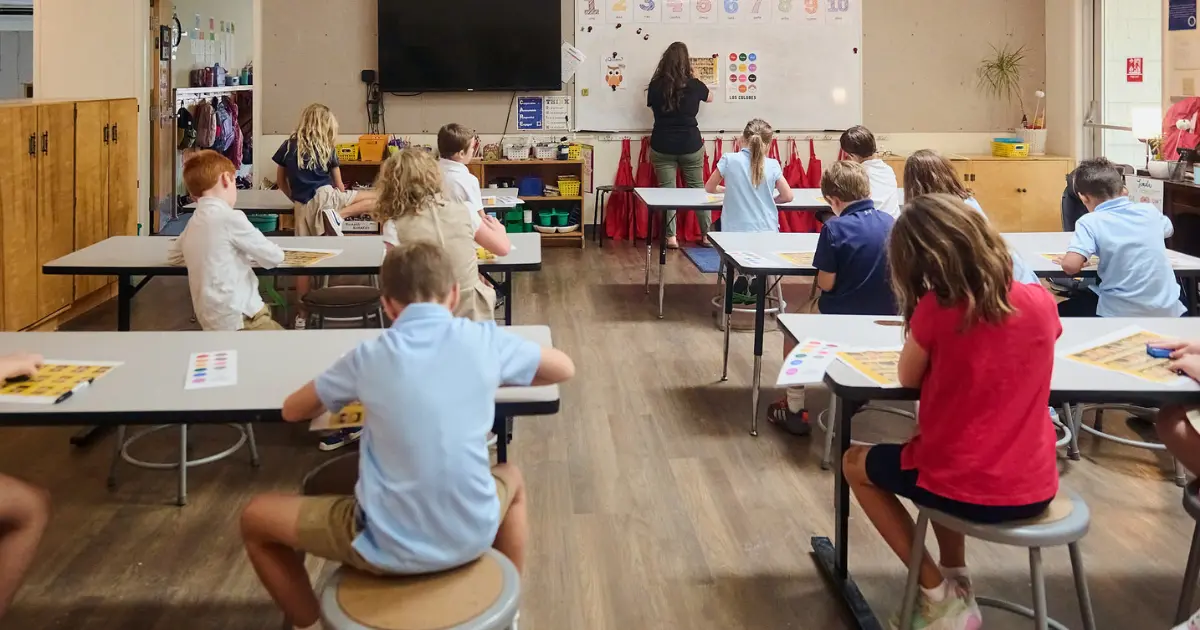
Research-informed teaching is embedded in everyday practice.
Teachers collaborate regularly to refine lesson design and assessment methods. Instruction is structured to strengthen memory and comprehension. Students are encouraged to reflect on their learning processes and develop the habits that prepare them for high school and beyond.
In the Lower School, foundational literacy and numeracy skills are built with intention and care. In Middle School, students are guided to think critically, engage deeply with content, and develop the independence necessary for secondary education.
This approach supports academic rigor while honoring the developmental needs of children.
Why Being the Only PK–8 in Maryland Matters
Kent School’s sustained partnership with CTTL over nine years demonstrates that this is not a passing initiative. It is part of our professional culture.
As the only PK–8 school in Maryland engaged in this nationally recognized collaboration, Kent School continues to invest in faculty development to ensure our teaching evolves alongside the science of learning.
This commitment strengthens our academic program and reinforces our mission to support the whole child — intellectually, socially, and emotionally.
The Long-Term Impact
Research-informed teaching supports:
- Strong study habits
- Academic independence
- Emotional resilience
- Confidence in challenging environments
- Readiness for competitive secondary schools
Families seeking a private school in Maryland often ask what distinguishes one independent school from another. At Kent School, the difference lies not only in our programs, but in the research and intentionality that shape them.
To better understand how tuition supports this level of intentional programming, read The Truth About Tuition at Kent School.
Experience the Difference
We invite families to learn more about how research-informed teaching shapes the Kent School experience.
Schedule a tour, speak with our admissions team, or explore our academic programs to see how our partnership with the Center for Transformative Teaching and Learning supports meaningful, lasting learning.